

-
-
SHOP




Enhancing Early Screening: Why Automated LBC Staining is the Next Step in Cytopathology
 2026-03-13
By admin
Cervical cancer continues to pose one of the largest yet avoidable threats to women’s health around the world. The World Health Organization has laid out clear goals to eliminate cervical cancer by 2030, but reaching those goals rests completely on the quality and speed of early detection efforts. For many years, laboratories have depended on manual Liquid-Based Cytology (LBC) and conventional Pap smears. Those approaches brought important improvements in their day, yet today they face growing difficulties in meeting current needs. The path ahead for cytopathology involves stepping away from the natural differences that come with manual work and adopting the steady accuracy of automated equipment.

Celnovte: A Global Leader in Pathological Precision
Celnovte stands at the leading edge of this change. With 30 years of focused work in pathology, Celnovte supplies diagnostic services to more than 2,300 leading hospitals and maintains a presence in over 40 countries. This wide reach helps make precise cancer diagnostics available in many places. All facilities follow NMPA and GMP rules, and the company holds key international approvals such as ISO13485, ISO9001, and CE IVDR. These certifications demonstrate a steady focus on maintaining top-quality standards.
Advancing the Cytology Workflow with the CNT 480/430 Systems
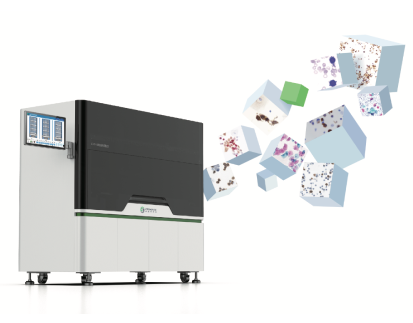
At the center of Celnovte’s cytology offerings sit the CNT 480 and CNT 430 series. These complete automatic liquid-based cytology stainers reshape the daily work of laboratories into more efficient and dependable operations.
Core Features: High-Throughput Automation and Precision Staining
The CNT 480 functions as a fully automatic immunocytochemistry (ICC) stainer built for slides prepared through LBC methods. One standout feature remains its processing capacity: the system handles 60 slides and finishes the full staining process within 2.5 hours. Automation manages every important part of the ICC sequence, including reagent application and controlled incubation. Laboratories that bring in these systems gain the ability to increase workload without a matching rise in staffing needs.
Engineering Excellence: Eliminating the Variability of Manual Processing
Manual staining carries unavoidable inconsistency. Small differences in how much reagent gets added, how long slides sit during incubation, or how washing takes place often produce uneven results across slides. The CNT 480 and CNT 430 systems apply careful engineering to deliver the same conditions for every slide. This consistent treatment forms the basis for reliable clinical decisions. A positive finding then reflects the true condition of the sample rather than uneven processing.

Clinical Case Solution: The Power of p16/Ki-67 Dual Staining
The CNT 480/430 hardware pairs naturally with Celnovte’s specialized reagent kits, especially the p16/Ki-67 dual staining system. This combination directly addresses one of the toughest issues in cervical screening: results that fall into uncertain categories.
Triage Success: Identifying High-Grade Lesions in HPV-Positive Cases
A frequent difficulty in current screening programs arises when many women test positive for high-risk HPV, yet only a small number go on to develop serious cervical changes (CIN2+). The CNT 480 automates staining for p16, which signals cell cycle disruption, and Ki-67, which marks active cell division. When both markers appear together in the same cell, that pattern strongly suggests harmful cell changes. Automation of this dual staining gives laboratories a specific tool for sorting patients, which helps cut down on unneeded colposcopy referrals and eases worry for many women.
Visual Clarity: Objective Interpretation via Color-Coded Results
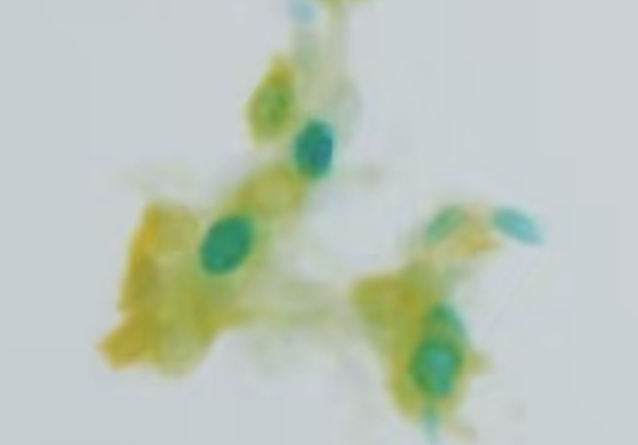
Reading conventional Pap smears demands long experience to spot faint cell shape differences. Celnovte’s p16/Ki-67 dual staining kits come in Green/Blue or Yellow/Cyan color options and change that task. Dual-stained cells stand out plainly under the microscope because of their distinct colors. This makes evaluation more straightforward and less dependent on personal judgment. Since the CNT 480 applies uniform staining intensity to every slide in a run, pathologists see dependable and clear signals batch after batch.
Application Scenarios: Solving Modern Laboratory Challenges
The practical value of the CNT 480/430 becomes clear when looking at the real settings where these systems address pressing operational issues.
Managing High-Volume Public Screening Programs
National or regional cervical cancer screening efforts often send thousands of samples to laboratories each week.
-
The Problem: Relying on manual staining for large numbers causes technician fatigue, raises the chance of sample mix-ups, and creates long delays that slow down patient follow-up.
-
The Solution: Adding the CNT 480 allows the laboratory to run a steady, high-volume process. Technicians load 60 slides and step away while the system completes staining in 150 minutes. The walk-away design removes the throughput limit and keeps large screening programs moving forward without constant oversight.
Standardizing Diagnostics in Multi-Center Hospital Networks
Hospital networks with many locations frequently deal with differences in diagnostic results between sites.
-
The Problem: Manual staining changes from one technician to another. A slide prepared at a smaller branch may appear noticeably different from one done at the main site, which can lead to conflicting reports for the same patient.
-
The Solution: Placing CNT 430 or CNT 480 systems at every location brings the same staining protocol across the network. Automation keeps p16/Ki-67 dual staining consistent, no matter who loads the slides or which facility handles the work. That uniformity supports stronger diagnostic accuracy and lowers the chance of overlooked findings throughout the entire system.
Conclusion: Securing the Future of Women’s Health
Shifting to automated LBC staining has become a necessary move rather than an extra choice for any cytopathology laboratory that aims to perform at a high level. The Celnovte CNT 480 and CNT 430 systems supply the practical means to manage rising sample numbers while raising the reliability of cervical cancer screening. Combining fast automation with the clinical strength of p16/Ki-67 dual staining helps laboratories work toward a time when missed diagnoses become far less common.
Ready to raise the standard of diagnostic work in your laboratory? Learn how Celnovte’s automated solutions can improve your daily processes and support better outcomes for patients.
-
Visit our website: www.celnovte.com
-
Contact us for a clinical consultation: info@celnovte.com | 0371-56596916/18
FAQ
Q: What are the primary risks of continuing with manual staining for LBC and ICC?
A: Manual staining brings noticeable variation in staining quality from slide to slide. It also carries a higher chance of mistakes during reagent handling and moves much more slowly, which creates delays in busy screening settings.
Q: Why is p16/Ki-67 dual staining preferred over traditional Pap smears for triaging HPV-positive cases?
A: Traditional Pap smears depend heavily on subjective reading and sometimes miss certain lesions. p16/Ki-67 dual staining delivers a clear, objective marker of oncogenic changes, which reduces both missed high-grade cases and unnecessary follow-up tests.
Q: How does automation impact the “Turnaround Time” (TAT) for a pathology lab?
A: Systems like the CNT 480 handle 60 slides in only 2.5 hours. That speed clears daily workloads far quicker than manual methods, allowing clinicians and patients to receive results much sooner.
Q: Is it difficult to transition a laboratory from manual to automated LBC staining?
A: No. Celnovte supplies fully automated workstations along with ready-to-use reagents built for walk-away operation. Staff members require only basic training to produce consistent, high-quality results.
![[Yellow/Cyan] P16/Ki-67 Dual Staining Detection Kit](https://www.celnovte.com/wp-content/uploads/2025/12/Immunofluorescence.jpg "[Yellow/Cyan] P16/Ki-67 Dual Staining Detection Kit")
![[Red/Brown] P16/Ki-67 Dual Staining Detection Kit](https://www.celnovte.com/wp-content/uploads/2020/08/1-7.gif "[Red/Brown] P16/Ki-67 Dual Staining Detection Kit")
