


Immunohistochemistry (IHC) plays an important role in modern pathology by helping laboratories identify specific antigens in tissue samples. As diagnostic testing and cancer research continue to develop, laboratories need reliable staining processes that support consistent results while making efficient use of available space and personnel.
A benchtop IHC stainer machine offers a practical approach to laboratory automation. Designed to fit on a laboratory bench, these systems combine automated staining functions with a relatively compact footprint. They are particularly relevant for hospital pathology departments, university research laboratories, third-party testing facilities, and laboratories looking to upgrade from manual staining without immediately adopting a large-scale automated platform.
Understanding the main features and operational considerations of these instruments can help laboratories select equipment that matches their daily workload and research requirements.
What Is a Benchtop IHC Stainer Machine?
A benchtop IHC stainer machine is an automated instrument designed to perform immunohistochemical staining on tissue sections mounted on microscope slides. Depending on its configuration, the system can automate several stages of the staining workflow, including slide baking, deparaffinization, antigen retrieval, blocking, antibody detection, and counterstaining.
Unlike larger standalone laboratory systems, benchtop models are designed with space efficiency in mind. They allow laboratories to introduce automated staining capabilities without requiring extensive changes to their existing workspace.
However, a compact design does not necessarily mean limited functionality. Modern benchtop IHC stainers can support multiple staining protocols, controlled reagent dispensing, temperature management, and software-based workflow monitoring.
Key Benefits of Using a Benchtop IHC Stainer
Efficient Use of Laboratory Space
Laboratory space is often limited, particularly in hospital pathology departments and university research facilities. Adding another instrument can require adjustments to existing equipment layouts and sample-processing areas.
A benchtop IHC stainer provides an alternative by integrating multiple staining functions into a single instrument. This helps laboratories improve workflow organization while maintaining space for other essential pathology equipment.
For facilities transitioning from manual IHC procedures, a compact automated system can also provide a more manageable starting point for laboratory automation.
More Consistent Staining Processes
IHC staining involves several variables, including reagent volume, incubation time, temperature, and washing conditions. When these steps are performed manually, differences in operator technique and timing can influence staining consistency.
An automated IHC stainer uses programmed protocols to control repetitive processing steps. This reduces unnecessary manual intervention and helps laboratories establish more standardized staining procedures.
For laboratories processing multiple specimens or repeating the same antibody protocols, controlled processing conditions can make daily operations easier to reproduce and monitor.
Reduced Manual Workload
Manual IHC staining requires technicians to manage multiple procedures throughout the staining process. As sample volumes increase, repetitive reagent dispensing, incubation monitoring, and slide handling can consume significant working time.
A benchtop IHC stainer automates many of these routine operations. Technicians can spend less time performing repetitive staining tasks and allocate more attention to specimen preparation, quality control, and result evaluation.
The actual workload reduction depends on the instrument's automation level, available protocols, and laboratory operating procedures.
Flexible Support for Different Applications
Not every laboratory performs the same type of staining. Clinical pathology laboratories may focus on routine diagnostic markers, while research facilities may require more flexible protocols for experimental applications.
Depending on the instrument, a benchtop IHC stainer may support conventional IHC, multiplex IHC, in situ hybridization (ISH), immunofluorescence (IF), or immunocytochemistry (ICC).
This flexibility allows laboratories to evaluate whether one automated platform can accommodate multiple testing requirements, potentially reducing the need for separate instruments.
Important Features to Evaluate When Selecting a Benchtop IHC Stainer Machine
Choosing an appropriate instrument requires more than comparing equipment dimensions or slide capacity. Laboratories should consider several practical factors.
Slide capacity and throughput: Evaluate how many slides the instrument can process simultaneously and whether additional slides can be loaded during operation. The capacity should match the laboratory's average daily workload and expected growth.
Temperature control: Antigen retrieval and other temperature-sensitive procedures require controlled heating conditions. Individual slide heating capabilities may provide greater flexibility when processing different protocols.
Reagent dispensing: Precise reagent delivery helps manage reagent consumption and supports consistent coverage of tissue sections. Laboratories should compare dispensing volumes, reagent container capacity, and compatibility with their existing protocols.
Protocol flexibility: Customizable staining programs are valuable for laboratories working with different antibodies, tissue types, and research applications.
Workflow monitoring: Software that displays reagent levels, processing status, running time, and error notifications can help technicians monitor instrument operation and identify issues more efficiently.
Maintenance and waste management: Accessible maintenance procedures and appropriate separation of hazardous and non-hazardous waste are also important considerations for long-term laboratory operation.
Celnovte Biotech CNT300: A Benchtop Automated IHC Staining Solution
For laboratories seeking automated staining capabilities in a benchtop configuration, Celnovte Biotech offers the CNT300 Full Automatic Multiplex IHC Stainer.
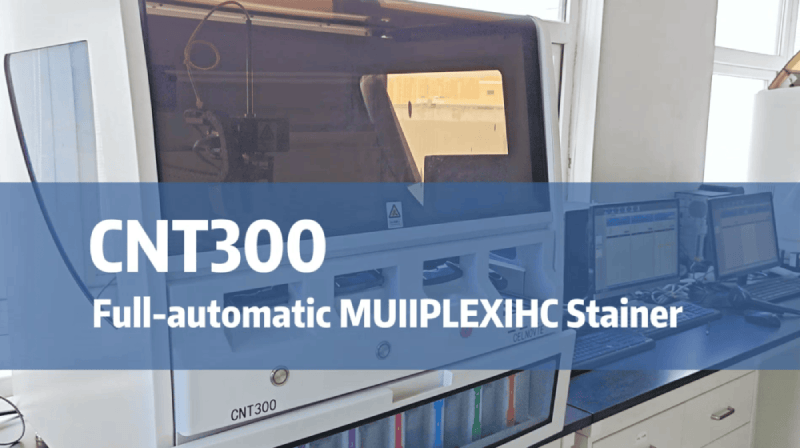
The CNT300 combines a compact instrument design with automated processing functions. It supports up to 30 slides across three independent trays, with 10 slides per tray, allowing laboratories to manage multiple staining batches within one system.
Its automated workflow covers slide baking, deparaffinization, antigen retrieval, blocking, detection, and counterstaining. The instrument supports IHC, multiplex IHC, ISH, IF, and ICC applications, providing flexibility for different pathology and research workflows.
Several features are particularly relevant to routine laboratory operations:
Continuous slide loading and unloading: Laboratories can add or remove slides during operation, helping maintain workflow flexibility.
Individual temperature control: Thirty independent heating units allow slides to be heated up to 100°C for antigen retrieval.
Flexible reagent dispensing: Selectable dispensing volumes of 100 µL, 120 µL, and 150 µL help laboratories manage reagent consumption.
Intelligent monitoring: Camera and infrared-based label identification help reduce manual identification errors, while the software displays reagent levels and processing information.
LIS integration: Customizable protocols and laboratory information system integration support more organized laboratory workflows.
Waste separation: Separate containers for hazardous DAB waste and non-hazardous waste help simplify waste management.
The system has a listed turnaround time of no more than 3.5 hours, depending on the selected protocol and operating conditions.
For laboratories comparing different automation levels, understanding how a fully automated IHC stainer differs from manual staining can provide additional context. Read our guide, Fully Automated IHC Stainer vs Manual Staining: Which Fits Your Lab?, to explore the differences in workflow control, operator involvement, and processing capacity.
Learn more about the Celnovte Biotech CNT300 Full Automatic Multiplex IHC Stainer and its technical specifications.
Conclusion
A benchtop IHC stainer machine can help laboratories introduce automated staining while making efficient use of available workspace. Its value depends on more than its physical size. Slide capacity, temperature control, reagent management, protocol flexibility, and software functionality all contribute to its suitability for daily laboratory operations.
For pathology laboratories, research institutions, and diagnostic testing facilities evaluating their next automation investment, selecting an instrument that matches current testing requirements while allowing room for future workflow development is essential.
Celnovte Biotech provides automated IHC staining solutions designed to support different laboratory applications and processing requirements. With integrated instrument and reagent capabilities, Celnovte Biotech helps laboratory partners explore more standardized and efficient pathology workflows.