


In clinical pathology laboratories, immunohistochemistry (IHC) staining is not simply about producing visible staining results. It is about delivering consistent, reproducible results that pathologists can rely on when evaluating tissue samples. As daily testing volumes increase and diagnostic workflows become more demanding, manual staining processes can introduce variations in reagent application, incubation conditions, and processing times.
Choosing the right IHC stainer for clinical lab operations therefore requires more than comparing processing speed or slide capacity. Laboratories should consider how well an instrument supports consistent staining conditions, standardized protocols, and predictable daily workflows.

For laboratories evaluating automation options, it is worth exploring Celnovte Biotech's IHC and pathology solutions. If turnaround time is also a concern, this guide to selecting a rapid IHC stainer offers additional insights into balancing processing speed and workflow requirements.
Consistent Staining Conditions Across Different Slides
One of the most important requirements for a clinical IHC stainer is its ability to maintain consistent processing conditions.
IHC results can be influenced by several factors, including antigen retrieval temperature, incubation time, reagent volume, and tissue coverage. When these conditions vary between slides or staining runs, the resulting staining intensity and background may also differ.
For clinical laboratories, an automated system should provide precise control over key staining parameters. Individual slide temperature control is particularly useful because it allows each slide to receive controlled heating conditions rather than relying entirely on a shared heating environment.
Consistent reagent delivery is equally important. Uneven reagent coverage or inconsistent dispensing volumes can affect staining quality, especially when processing multiple specimens simultaneously.
When evaluating a clinical IHC stainer, laboratories should look for:
Precise temperature control during antigen retrieval and staining.
Consistent reagent dispensing across different slides.
Uniform reagent coverage throughout the staining process.
Stable processing conditions across repeated runs.
These features help reduce avoidable variations and make staining results more consistent from one run to another.
Standardized Protocols That Reduce Operator Variation
Another key consideration when choosing a pathology IHC stainer is how effectively it standardizes routine laboratory procedures.
In many clinical laboratories, different technicians may handle staining tasks across multiple shifts. If important steps depend heavily on manual timing, reagent application, or individual operating habits, differences between operators can affect workflow consistency.
An automated IHC stainer helps address this challenge by integrating essential staining procedures into predefined protocols. Steps such as slide baking, deparaffinization, antigen retrieval, blocking, detection, and counterstaining can be managed through automated processing sequences.
Customizable protocols are also important. Clinical laboratories may work with different antibodies, tissue types, and staining requirements. The ability to configure and maintain appropriate protocols allows laboratories to standardize routine procedures without losing the flexibility needed for different testing applications.
When comparing a clinical IHC stainer with other options, consider whether its software supports protocol customization, process monitoring, and repeatable operation. An intuitive interface can also make it easier for technicians to follow established procedures and identify potential issues during processing.
Reliable Sample Identification and Workflow Traceability
Clinical laboratories process specimens that must remain correctly identified throughout the staining workflow. Sample mix-ups can create serious operational problems, making reliable slide identification an important part of instrument selection.
Automatic barcode recognition can reduce dependence on manual identification and help technicians manage multiple specimens more efficiently.
A well-designed system should also provide clear information about reagent availability, processing status, running time, and instrument alerts. These functions help laboratory personnel monitor ongoing operations and respond to potential problems before they affect the entire workflow.
For laboratories using laboratory information systems (LIS), integration is another useful consideration. LIS connectivity can support better coordination between sample information and instrument operations, reducing repetitive manual data entry and improving workflow management.
A suitable pathology IHC stainer should therefore support not only the staining process itself but also the identification and monitoring tasks surrounding it.
Workflow Flexibility for Routine Clinical Testing
Consistency does not mean every specimen must be processed in exactly the same batch or at the same time.
Clinical laboratories often receive samples throughout the working day. Some specimens follow routine schedules, while others may require priority processing. An instrument that only operates with fixed batch loading may create unnecessary waiting time when urgent slides arrive.
Continuous loading provides a practical alternative. It allows technicians to introduce additional slides during an ongoing run instead of waiting for the entire batch to finish.
When evaluating an IHC stainer for clinical lab use, consider its actual slide capacity, loading flexibility, turnaround time, and ability to accommodate different testing requirements.
The goal is to maintain standardized staining conditions while allowing the laboratory to respond to changing sample volumes and priorities.
Consider an Automated IHC Stainer Designed for Clinical Workflows
For laboratories looking to improve staining consistency and standardize daily procedures, the Celnovte Biotech CNT320 Fully Automated IHC/ISH Stainer is one option worth evaluating.
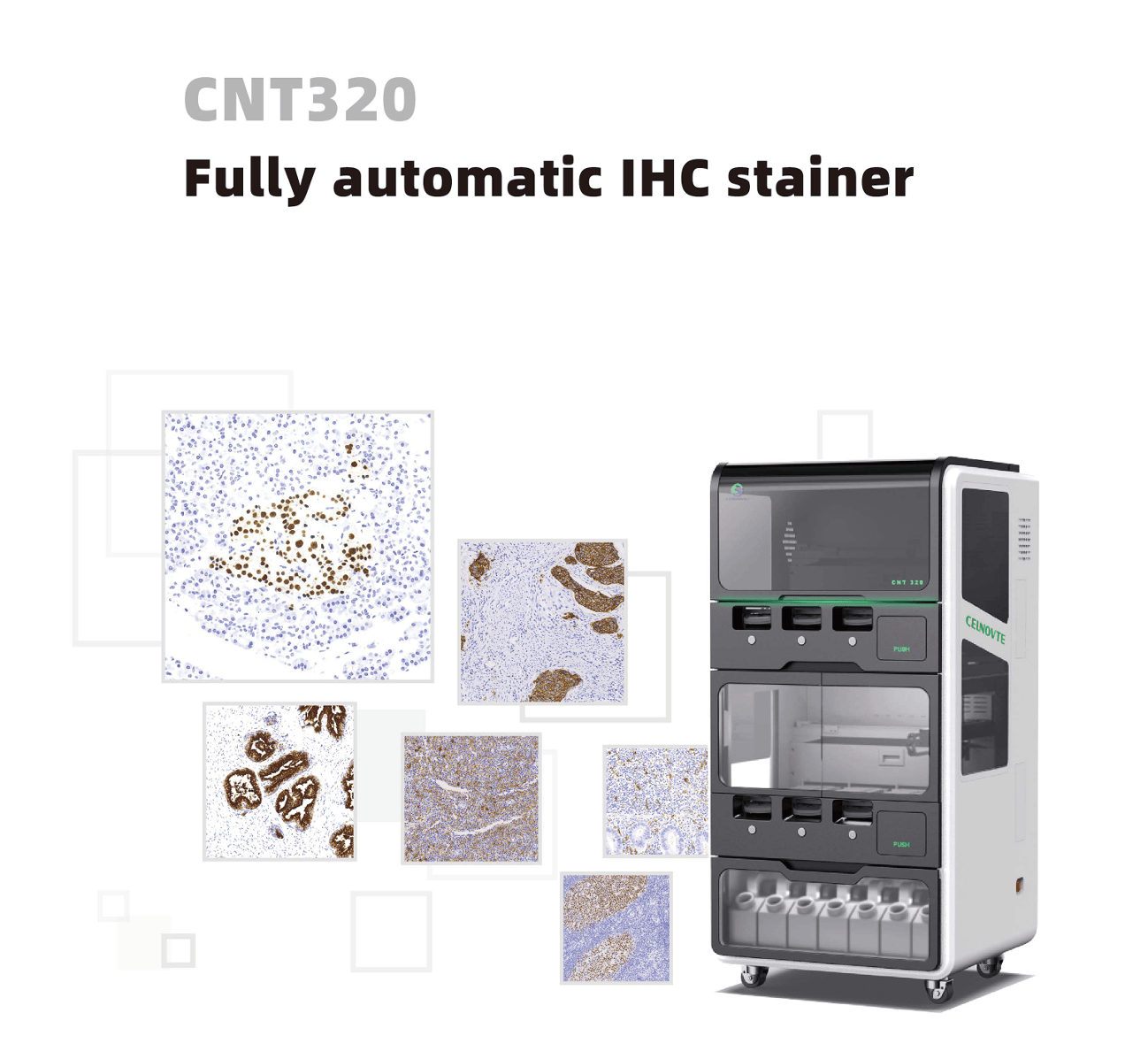
Designed for medium- to high-throughput pathology laboratories, the CNT320 accommodates up to 60 slides across six independent trays, with 10 slides per tray. Its continuous loading and unloading capability allows technicians to manage incoming specimens without waiting for a complete batch cycle.
Several features are particularly relevant to clinical laboratory workflows:
Individual slide temperature control: 60 independent heating units support controlled heating conditions for individual slides, including antigen retrieval.
Automatic barcode recognition: Camera and infrared recognition technologies help reduce manual slide identification errors.
Selectable reagent dispensing: Adjustable dispensing volumes of 100 μL, 120 μL, and 150 μL allow reagent delivery to be matched to staining requirements.
MicroStacker™ detection technology: The detection system, together with a solid-liquid cover film, helps maintain uniform reagent coverage and reduce evaporation.
Customizable protocols and LIS integration: These functions support standardized processing and coordination with existing laboratory workflows.
The CNT320 has a stated turnaround time of no more than 3.5 hours and supports IHC, ISH, Multiplex IHC, ICC, and IF protocols.
For clinical laboratories, the value of these features lies in their combined contribution to more controlled processing, reduced manual intervention, and flexible daily operations.
Learn more about the Celnovte Biotech CNT320 Fully Automated IHC/ISH Stainer and explore its specifications to determine whether it matches your laboratory's testing requirements.
Evaluate Reproducibility, Not Just Processing Speed
A fast instrument is not necessarily the best choice for every clinical laboratory. While shorter turnaround times can improve operational efficiency, consistent staining performance and standardized procedures should remain central to the selection decision.
Before purchasing, laboratories should consider their daily slide volume, the range of staining protocols they perform, the level of automation required, and how easily the instrument can fit into existing workflows.
It is also useful to evaluate the system using representative tissue samples and established laboratory protocols. Comparing staining consistency across repeated runs can provide a more practical understanding of its performance than relying on specifications alone.
Ultimately, a suitable IHC stainer for clinical laboratories should make routine staining more controlled, repeatable, and manageable. By prioritizing temperature control, standardized protocols, reliable sample identification, and workflow flexibility, laboratories can choose an automated system that supports consistent diagnostic workflows as testing demands grow.
Looking for an IHC automation solution for your clinical laboratory? Explore Celnovte Biotech's IHC automation systems or contact the Celnovte Biotech team to discuss your laboratory's workflow, slide capacity, and staining requirements.